From 13 February – 8 May 2016, Het Noordbrabants Museum in ’s-Hertogenbosch will present the international exhibition Jheronimus Bosch – Visions of genius. With an expected 20 paintings (panels and triptychs) as well as 19 drawings, this will be the largest Jheronimus Bosch (circa 1450 – 1516 ’s-Hertogenbosch) exhibition ever. It will provide an unparalleled homage to the most important Medieval painter this country has known: never before were so many works by this devilish artist brought together in a single place. As a one-off, the majority of his oeuvre will return to ’s-Hertogenbosch, the city he was born in as Jeroen van Aken, where he painted his masterpieces and that he derived his artist’s name Bosch from. The exhibition is the highlight of the Jheronimus Bosch 500 National Event Season that will be celebrated in 2016 occasioned by the 500th anniversary of the painter’s death.
Ticket Sales
Exceptional number of works loaned
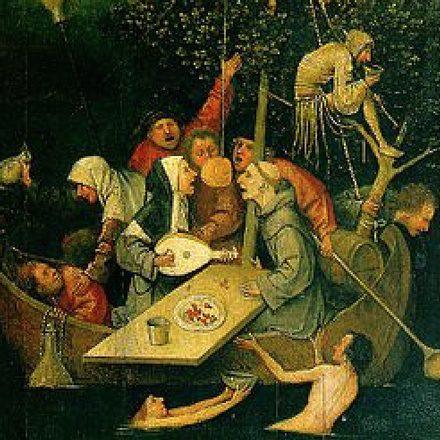
The dozens of loaned works originate from prominent museums around the world including the Museo Nacional del Prado (Madrid), Museum Boijmans Van Beuningen (Rotterdam), Gallerie dell’Accademia/Palazzo Grimani (Venice) and the Metropolitan Museum (New York). Among them works such as the Cure of Folly and the Temptation of Saint Anthony (Museo Nacional del Prado, Madrid), the Ship of Fools (Musée du Louvre, Paris), Death and the miser (National Gallery of Art, Washington) and the Hermit Saints triptych (Gallerie dell’Accademia, Venice). The remarkable number of works loaned to the exhibition provides visitors with a unique opportunity to extensively study Jheronimus Bosch’s revolutionary, fantastic visual language.
Jheronimus Bosch
Bosch’s work is typified by the monsters, demonic figures, angles and saints who famously inhabit his drawings and panels. His characteristic work full of illusions, hallucinations, wondrous freaks and nightmares and inimitably illustrates the major themes of his era: temptation, sin and judgment. Working during the period around 1500, the transition between the Middle Ages and the Renaissance, Jheronimus’ paintings and graphic work magically reflect the relationship between man, his environment and his creator. Jheronimus Bosch is viewed as an artistic genius who depicted worlds in his work that his contemporaries considered impossible. As an artist he is one of the world’s best, whose work was emulated by the generations that followed and continues to inspire new artists to this day.
“Jheronimus Bosch is the most important, most original Medieval artist to originate from the Netherlands. It is fabulous that in 2016 most of his heritage will be on show in the city of his birth ’s-Hertogenbosch. Marvellous that a new generation will be able to become acquainted with this entirely unique work,” says Charles de Mooij, Director of Het Noordbrabants Museum
Large-scale research
Preparations for the exhibition at Het Noordbrabants Museum started in 2007. The foundations for the loan of the exceptional works were laid by the Bosch Research and Conservation Project (BRCP), an ambitious, large-scale, international art historical study set up in collaboration with the Stichting Jheronimus Bosch 500 and Radboud University Nijmegen. Over the past six years, a team of international experts united in the BRCP has, for the first time ever, intensively, systematically studied and documented Bosch’s oeuvre. Moreover, as a follow-up to that research and in preparation for the ‘s-Hertogenbosch exhibition, a large number of the paintings were restored. The Bosch Research and Conservation Project’s results constitute the basis for the 2016 exhibition.
Bosch year 2016
In the city of ’s-Hertogenbosch, inhabitants and visitors have been commemorating the 500th anniversary of the death of the Netherlands’ most important Medieval painter Jheronimus Bosch (circa 1450 – 1516) with a multi-year, international series of Jheronimus Bosch 500 cultural events since 2010. His era and themes were and will be brought back to life at a wide range of festive events such as special music, dance, theatre and circus productions, exhibitions, public space projects, light presentations, books, games and apps inspired by the bottomless well of inspiration that is Jheronimus Bosch’s work. All for (and by) a diverse audience, both young and old from the Netherlands and abroad. Jheronimus Bosch 500 hereby brings the most famous son of the city back to where he conceptualised and made it all: ’s-Hertogenbosch.
Many thanks to
The exhibition is part of the Jheronimus Bosch 500 season of events and was co-funded by, among others, the Municipality of ’s-Hertogenbosch, the Provincial Government of Noord-Brabant, the Cultural Heritage Agency of the Netherlands, the Ministry of Education, Culture and Science, BankGiro Loterij, Essent, Rabobank, KLM, Gieskes-Strijbis Fonds, Fonds 21, Ammodo and the Prins Bernhard Cultuurfonds.